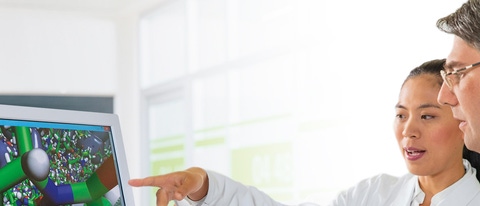
Digitalization in research helps make research work more efficient, expand knowledge networks and create more room for creativity. Chemist Dr. Fangfang Chu and Dr. Eduard Schreiner, an expert in molecular simulations, discuss the computer simulation of microencapsulation. These are used to protect active ingredients from moisture and oxygen, for example. Simulations can help improve the understanding and prediction of the complex chemical and physical interactions within the microcapsule. This enables laboratory test series to be planned more effectively.

Who we are

Our Research and Development

Effective and efficient R&D is a prerequisite for innovation. We are well positioned: With approximately 10,000 employees around the globe, we work on sustainable solutions for our customers every day. We benefit from the growing opportunities that digitalization and supercomputing power offer us.

Our most recent topics and highlights

More and more electric cars are registered worldwide every year. At the same time, the raw materials for the batteries are limited and mining them is associated with negative environmental impact. BASF researchers at the Ludwigshafen site are therefore developing a new chemical process to recycle high-purity lithium from these batteries. This will also avoid waste and reduce the CO2 footprint compared to existing recycling processes.Chemical engineer Dr. Matthias Voges (left) and chemist Dr. Kerstin Schierle-Arndt (right) examine the lithium salts obtained from the new process.
Research focus
We are a global leader in chemical industry R&D. Our researchers in labs around the globe are working on hundreds of research projects to meet the challenges of our customers.

Our global R&D network

Our three global research divisions are run from our key regions – Europe, Asia Pacific and North America - complementing our customer-facing business segments to form the core of our Know-How Verbund.

Our global team of chemists and engineers work to optimize existing processes and develop new ones for the whole BASF value chain. With our competencies in heterogeneous and homogeneous catalysis, we provide catalysts for new and existing processes. Characterization, testing and up-scaling are part of this research. Our research also focuses on innovative cathode active materials for high-performance lithium-ion batteries used in e-cars and on technologies to reduce the carbon footprint of our products and processes.
At Bioscience Research, we drive innovative, sustainable solutions for agricultural, food and industrial applications by unleashing the potential of biosciences to help create a better life and an improved environment. We progress our technology leadership to realize sustainable and differentiated value – for our customers, partners and for BASF. Our global presence provides the necessary foundation and strength for long-term success in this field.
At Advanced Materials & Systems Research, we are innovating to make a valuable contribution to our customers and the world we are living in. Together with BASF's divisions and our academic partners we develop functional materials and systems for high performance and sustainable solutions for our customers in various industries. We are using our expertise in structural and functional materials, biobased/biodegradable products, dispersions, additives, coatings, composites as well as hybrids, multi-materials and formulations for a wide range of customers from the automotive and construction industries, packaging, coatings, home and personal care, consumer goods, nutrition.

Our methods and enablers

Digitalization in R&D
We integrate digital technologies into everyday operations and make them an integral part of any R&D project workflow to boost effectiveness of research, increase efficiency and open up new innovation opportunities - and we are supported for example from the supercomputer Quriosity.