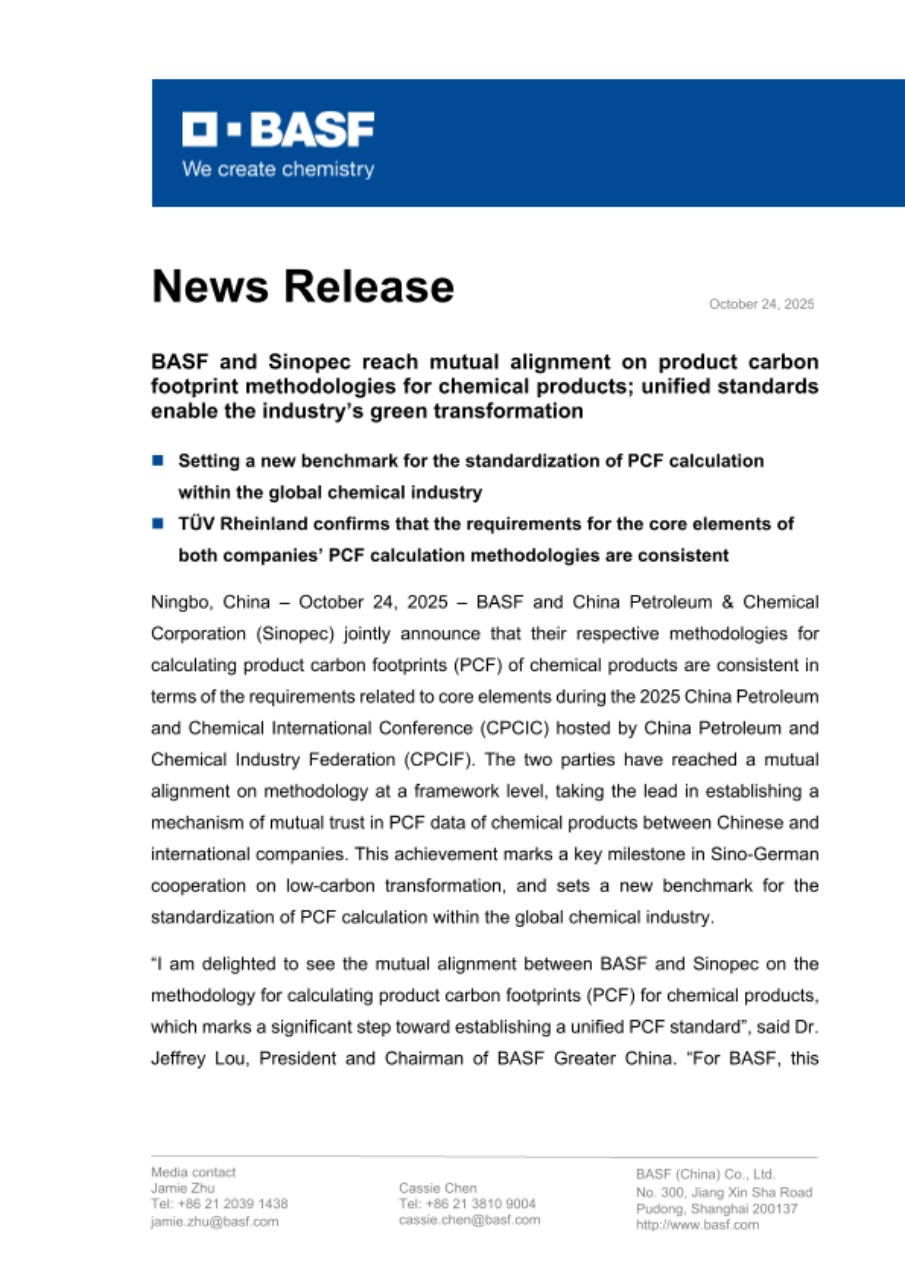
BASF and Sinopec reach mutual alignment on product carbon footprint methodologies for chemical products; unified standards enable the industry’s green transformation
- Setting a new benchmark for the standardization of PCF calculation within the global chemical industry
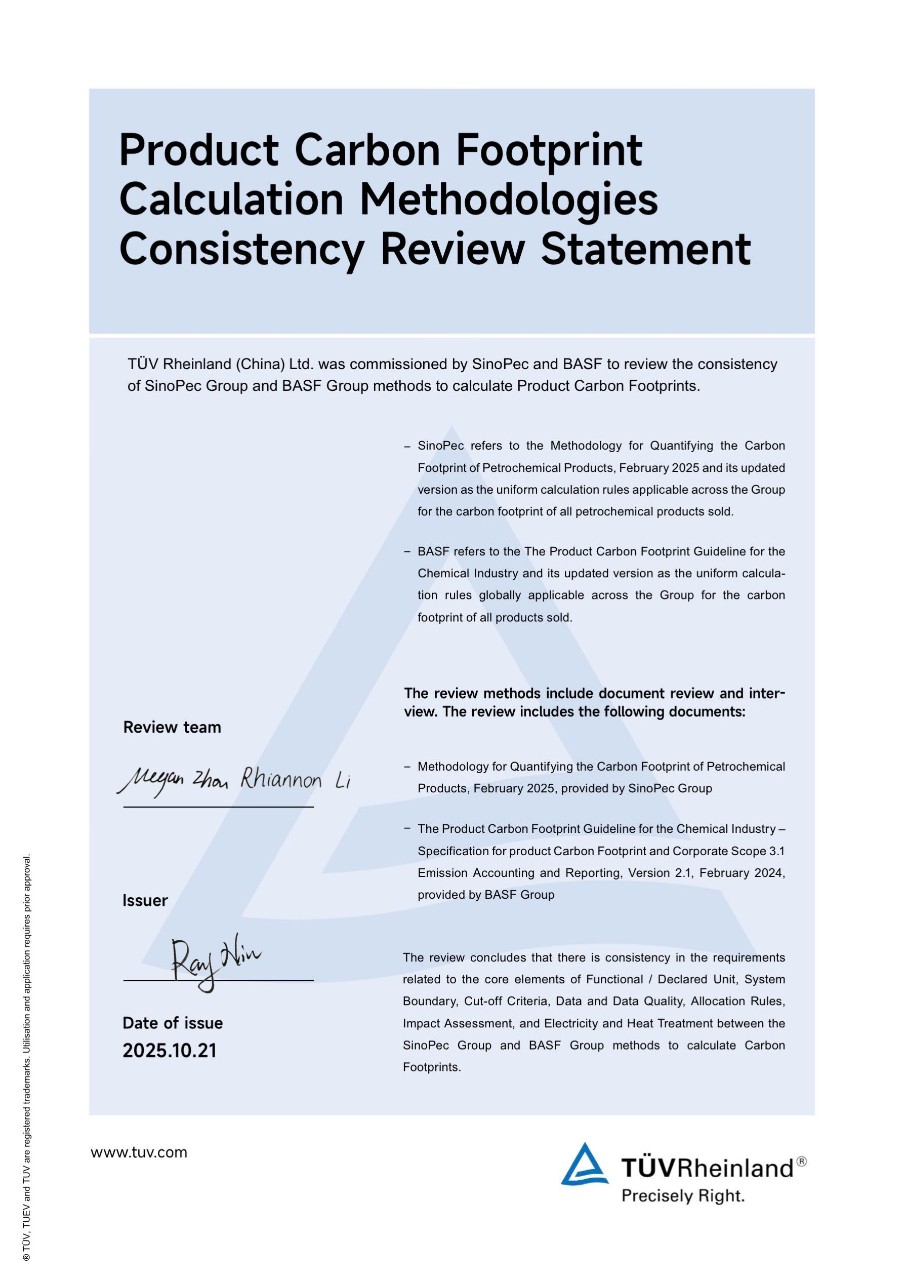
- TÜV Rheinland confirms that the requirements for the core elements of both companies’ PCF calculation methodologies are consistent
Ningbo, China – October 24, 2025 – BASF and China Petroleum & Chemical Corporation (Sinopec) jointly announce that their respective methodologies for calculating product carbon footprints (PCF) of chemical products are consistent in terms of the requirements related to core elements during the 2025 China Petroleum and Chemical International Conference (CPCIC) hosted by China Petroleum and Chemical Industry Federation (CPCIF). The two parties have reached a mutual alignment on methodology at a framework level, taking the lead in establishing a mechanism of mutual trust in PCF data of chemical products between Chinese and international companies. This achievement marks a key milestone in Sino-German cooperation on low-carbon transformation, and sets a new benchmark for the standardization of PCF calculation within the global chemical industry.
“I am delighted to see the mutual alignment between BASF and Sinopec on the methodology for calculating product carbon footprints (PCF) for chemical products, which marks a significant step toward establishing a unified PCF standard”, said Dr. Jeffrey Lou, President and Chairman of BASF Greater China. “For BASF, this initiative not only contributes to achieving our 2050 net zero target1, but also enables our downstream customers to track the carbon footprints of chemical products and to accelerate their green transformation.”
Prior to the announcement, the two companies engaged in in-depth exchanges on their respective methodologies for calculating PCF of chemical products and jointly commissioned TÜV Rheinland, a globally recognized third-party certification body, to conduct a consistency review. Following multiple evaluations, TÜV Rheinland has confirmed that both methodologies are compliant with the international standard ISO 14067:2018 and the national standard GB/T 24067–2024, and are consistent in the requirements related to core elements, issuing an official statement of consistency.
About BASF
At BASF, we create chemistry for a sustainable future. Our ambition: We want to be the preferred chemical company to enable our customers’ green transformation. We combine economic success with environmental protection and social responsibility. Around 112,000 employees in the BASF Group contribute to the success of our customers in nearly all sectors and almost every country in the world. Our portfolio comprises, as core businesses, the segments Chemicals, Materials, Industrial Solutions, and Nutrition & Care; our standalone businesses are bundled in the segments Surface Technologies and Agricultural Solutions. BASF generated sales of €65.3 billion in 2024. BASF shares are traded on the stock exchange in Frankfurt (BAS) and as American Depositary Receipts (BASFY) in the United States. Further information at www.basf.com.
About Sinopec
Sinopec Group is the largest oil and petrochemical products supplier in China, and the largest refining company and the second largest chemical company in the world. Its total number of gas stations ranks the second place in the world. It has been ranking among the top on Fortune's Global 500 List in recent years.

1 Scope 1, Scope 2, and Scope 3 (excluding the sale of energy to third parties, including offsetting). The target includes greenhouse gases according to the Greenhouse Gas Protocol, which are converted into CO2 equivalents (CO2e).