November 19, 2026

Media

The sound of innovation

Whether in an office, a restaurant or on a train, good acoustics make us more comfortable, often without us even noticing. With Basotect®, BASF has developed a material that absorbs sound, provides thermal insulation and meets stringent fire safety requirements. In this interview, Sebastian Alexander Weiße explains where we encounter the foam in everyday life and why its properties are in demand across so many applications. Here you can listen to the interview in our podcast.

Dr. Sebastian Weiße

Where do people first notice Basotect®?

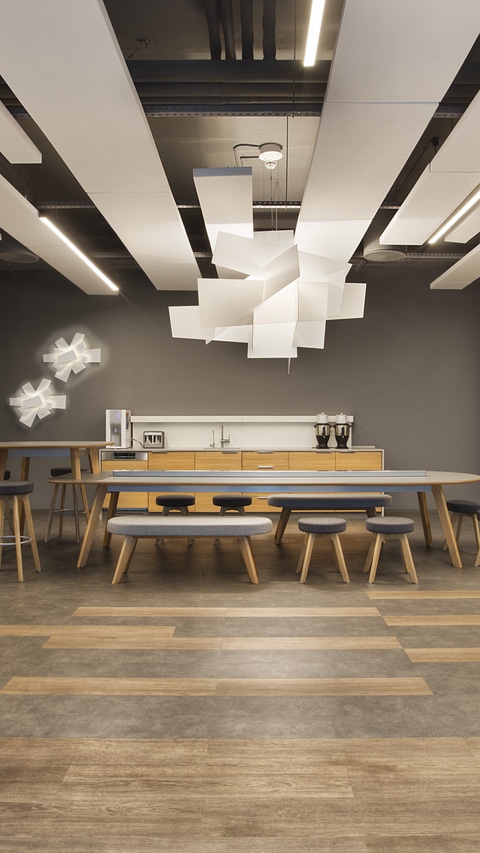
Dr. Sebastian Alexander Weiße: We notice sound immediately, even if we are often unaware of it. A room can look perfect and still feel uncomfortable if the acoustics are poor, because sound bounces off the walls and ceilings. Basotect can improve acoustics in restaurants, hotel lobbies, cinemas and meeting rooms, for example. In an office, good acoustics make it easier to follow a presentation or conversation, helping teams work more productively. Anyone working in a factory hall or living next to a nightclub also appreciates a reduction in noise. 


How does sound absorption work?

Basotect’s particular strength lies in its open-cell structure. Rather than simply being reflected, sound waves penetrate deep into its fine network of cells, where the sound energy is dispersed. This creates a more pleasant acoustic environment. 

Cubes made of Basotect.
Basotect baffles hanging from the ceiling in the Barceló Raval design hotel in Barcelona, Spain.
Basotect sound absorbers are improving the room acoustics in the Barceló Raval design hotel in Barcelona, Spain.

What makes Basotect special?

Basotect combines several properties that are rarely found in a single material: the foam is extremely lightweight, offers excellent sound absorption and provides good thermal insulation, helping to save energy. It also meets stringent fire safety requirements. This makes it suitable for a wide range of acoustic applications in buildings, vehicles and industrial facilities. With Basotect, our customers can combine comfort, safety and sustainability with attractive design.


Can you give us some specific examples?

Vehicles such as trains and cars often need to meet two requirements that are not always easy to reconcile: keeping weight as low as possible to reduce energy consumption while meeting stringent fire safety requirements. Basotect is the perfect solution here. Passengers benefit from reduced noise, especially in crowded train carriages. Specific examples include Spain’s Talgo 350 high-speed train, which uses Basotect in its interior lining, and subway trains in South Korea. 

Another example is the National Aquatics Center in Beijing, China. It accommodates 17,000 spectators, which naturally means considerable noise levels. To keep that noise from becoming disruptive, the swimming venue features a specially developed ceiling structure made of large Basotect panels that blend into the architectural design and are suitable for the high humidity. 

National Aquatics Center in Beijing
Basotect was used for the ceiling of the National Aquatics Center in Beijing, China.
Hand cleaning footprints on floor with a dirt eraser.
Basotect EcoBalanced has a reduced CO2 footprint.

How sustainable is Basotect?

We are continuously working to reduce the CO₂ footprint of our materials. With Basotect EcoBalanced, we have developed the world’s first melamine resin foam with a significantly reduced CO2 footprint. We achieve this by using 100 percent green electricity in production and renewable raw materials through a certified mass balance approach. This also makes it easier for our customers to achieve their sustainability goals. 


Are there any recent innovations?

One example is Basotect Dark EcoBalanced, the first dark version of our melamine resin foam. It combines the benefits of Basotect with a contemporary dark shade that reflects current interior design trends. This opens up new design possibilities for acoustic solutions in dark interiors, while also helping to reduce the CO₂ footprint.

Black cube made of Basotect Dark EcoBalanced.

What is your personal connection to Basotect?

When my sons’ kindergarten was renovated, Basotect was installed on the walls. With 20 lively children in the room, that makes a huge difference. Once the room’s acoustics improved, even the children with the loudest voices quickly realized they no longer needed to shout to be understood. This brought a lasting reduction in noise levels, making the space much more pleasant for both the children and their teachers.   

Dr. Sebastian Alexander Weiße is Head of Global Research and Product Development Basotect® at BASF. In this role, he drives the development of Basotect, BASF's melamine resin foam. The material combines sound absorption, thermal insulation and flame resistance, helping improve comfort, safety and energy efficiency across a wide range of applications. 

Weiße joined BASF in 2012. He holds a PhD in Physical Chemistry from Heidelberg University and completed postdoctoral research at the Karlsruhe Institute of Technology (KIT) in Germany.