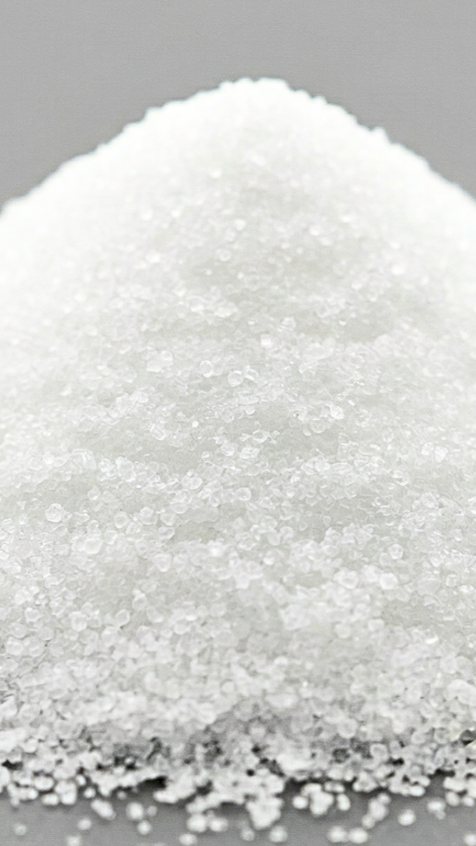
Salt crystals
April 16, 2026

Media

Storing sunshine in salt

Renewable energy is great – but what if there is no breeze or a plant needs energy at night? Industry can’t hit pause when the sun or wind does. One promising answer is unexpectedly simple: salt. Molten nitrogen salts can store renewable power as high-temperature heat – and release it on demand, like a battery. We spoke with Nils-Olof Born, expert for nitrogen salts at BASF, about this innovative approach. Here you can listen to the interview in our podcast.   

What makes nitrogen salts so special?

For some of them, when you mix two or more together, the melting point of the mixture drops dramatically – so low that scientists call them “molten salts” because they are so easy to melt. This low melting point enables the salt mixtures to be stored and used in a liquid state.

Christoph Jäkel is Vice President Corporate Sustainability at BASF.
Dr. Nils-Olof Born, BASF expert for nitrogen salts. 
Wing of an offshore wind turbine
How can we use wind power when there is no wind?

What is the benefit?  

Molten salts can hold a lot of heat, without taking up too much space. In addition, due to their liquid form, they are pumpable and easily usable in highly efficient heat exchangers. This makes them ideal for storing renewable energy as heat – a key benefit during periods when the sun does not shine or there is no breeze.

Can you give a project example?  

In the autumn of 2025, BASF provided the salt mixture for the world’s first industrial, salt-based thermal energy storage system, the so-called Heatcube. It was built by Kyoto Group close to Budapest, Hungary, to supply heat to a corn-processing facility. The Heatcube works like a battery that stores energy – not in the form of electricity, but as high-temperature heat – in molten salt. The salt mixture is heated by an electric heater to over 400 degrees Celsius as soon as large quantities of low-cost, renewable electricity become available on the grid. The resulting heat can be used for on-demand steam generation or stored for periods of low renewable availability and higher prices.

How does it work?

The Heatcube works like a battery that stores energy – not in the form of electricity, but as high-temperature heat – in molten salt. The salt mixture is heated by an electric heater to over 400 degrees Celsius as soon as large quantities of low-cost, renewable electricity become available on the grid. The resulting heat can be used for on-demand steam generation or stored for periods of low renewable availability and higher prices.

Picture of the the new Zhanjiang Verbund site in China taken from birds' perseptive
The Heatcube in Hungary is the world’s largest industrial thermal energy storage system.
Wood pellets
Steam is essential for industrial production. 

Why is steam so important?  

Industries need large amounts of steam for their processes – whether in chemicals, food, or other sectors. When that steam is produced from fossil fuels, it generates significant CO2 emissions. CO2‑free steam technologies are, therefore, an important step toward industrial decarbonization. For example, the Heatcube in Hungary will supply more than 30 GWh of clean process heat for steam each year, replacing natural gas and potentially cutting CO2 emissions by up to 8,000 tons annually.

Will BASF also use this technology for its plants?

BASF is evaluating the use of this technology especially at smaller sites with direct connection to renewable energy sources and will start to scale up its investments on power-to-heat technologies starting from 2028/2029. Technologies with molten salt heat storage are part of this evaluation.

Are there similar projects planned?

Yes, we are seeing an increasing pipeline of molten salt energy storage projects and are in contact with several companies in this field developing projects especially in Europe. We are also working with academic partners like the German Aerospace center to optimize the use of our salts in this application.

Frank Reil, Marcel Schmitt (both BASF) and René Bethmann (VAUDE) with the new TRAILCONTROL ZERO 20+ backpack.
There are more and more energy storage projects using salts.

Dr. Nils-Olof Born has been Global Marketing and Product Manager for inorganic salts at BASF since 2022. He studied chemistry from 2007 to 2013 at Johannes Gutenberg University Mainz, Germany, the University of Toronto, Kanada and the Max Planck Institute in Dresden, Germany. He then completed his doctorate at BASF from 2014 to 2017 and subsequently took over the leadership of a laboratory group in the field of inorganic materials.