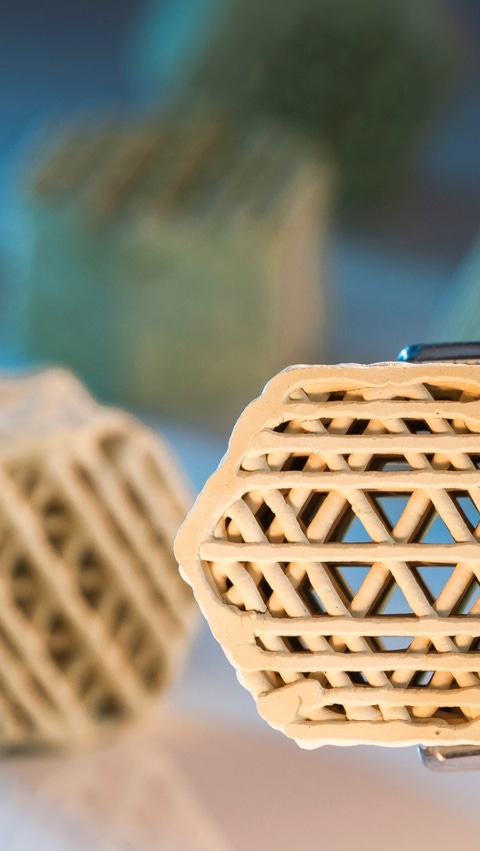
Close-up of a ceramic catalyst support with a complex structure held by tweezers; several similar structures blurred in the background.
June 16, 2026

Media

From crazy idea to great innovation

A catalyst from a 3D printer? Many people initially laughed at BASF catalyst expert Marco Kennema, PhD, and his team for this idea. But they stayed committed and are now proud of their innovation, which helps customers to boost profit and save CO2. We met Marco for an interview. Here you can listen to it in our podcast. 

You are an expert in catalysts. What does a catalyst do?

Marco Kennema: In simple terms, a catalyst helps a chemical reaction happen more easily. With the right catalyst, manufacturers can run the process at a lower temperature and in a more efficient way, saving energy, CO2 and costs. In the end, they get more of the desired product, as the majority of molecules have reacted as they should. 

Marco Kennema, expert for catalysts at BASF.
Marco Kennema, PhD, is Global Business Director for Oxidation and Dehydrogenation Catalysts at BASF in Shanghai.
Fingers holding semiconductor chips.
Sulfuric acid is used for the production of semiconductor chip, for example.

Which product are you responsible for?

My team and I are responsible for providing catalysts to the chemical industry and one of these industries produces sulfuric acid – one of the most widely used chemicals in the world. It plays a role in making fertilizers for farming, ingredients for cleaning products or the production of semiconductor chips, for example. So even if people do not notice it, sulfuric acid is a crucial part of modern everyday life.

Which catalyst is used for this?

For more than 100 years, almost every company has used vanadium pentoxide. What has changed over time is the catalyst’s shape: The early catalysts were cylinders, followed by a star shape with a hole in the middle. A real innovation was the launch of BASF’s Quattro catalyst in 2019 with four holes inside their clover-leaf shape. It significantly lowers the reaction temperature and pressure drop and by doing so conserves energy. The increased surface area helps to convert almost every last atom of sulfur into sulfuric acid.

Bowl with Quattro catalysts.
Bowl with Quattro catalysts. 
Hand holding X3D catalysts.
The X3D catalyst is printed by a 3D-printer. 

How could you improve on that?

Our idea was to use a 3D printer for the production of an innovative catalyst. This works like a 3D printer you have at home, where you push melted plastic through a nozzle to get the shape you want. Just that we use another material. Our new catalyst is called X3D®, is a bit bigger than a quarter coin and looks somewhat like cereal. 

How did you know that it works? 

Instead of going through hundreds of testing experiments with the new catalyst, we went straight to a BASF plant – even though at the time everyone in the lab thought we were crazy. We said, we’ll put it in the reactor and we’ll see what the performance is because it will not be worse than the current catalyst they have. In the end, it actually performed much better than their previous catalyst: The innovative shape led to a higher reactor throughput, substantially lower energy consumption and a longer lifespan of the catalyst itself, which is at 7 years and counting.  

BASF team checks the X3D catalysts in a barrel. 
Two BASF colleagues look into a reactor filled with X3D catalysts.
View into a reactor filled with X3D catalysts.

What is the benefit for your customers?

It makes their production way more efficient and increases their earnings. Since the chemical composition of the X3D catalysts is identical to star-ring or Quattro, people can easily switch to the new one with minimal risk since the material already works under existing operating conditions.

How was this success possible?  

Well, I always say that great innovations come from crazy ideas. I think you need people who are willing to take that risk with a bit of a financial eye to see that it actually makes sense for the customer. This is key at BASF: We’re always trying to make an innovation that’s going to help our customers be more successful.

Marco Kennema, PhD, is Global Business Director for Oxidation and Dehydrogenation Catalysts at BASF in Shanghai, China. Before he was Head of Digitalization Process Catalysts in Ludwigshafen, Germany. Earlier in his career Marco worked in R&D as a chemist in Ludwigshafen. There he developed the Quattro catalyst for the conversion of sulfur dioxide (SO2) to sulfur trioxide (SO3) and took the X3D catalyst technology from concept to commercialization, generating more than 20 patents.

Kennema completed his PhD at the Max‑Planck‑Institut für Kohlenforschung in Mühlheim, Germany, and earlier earned a Master of Science in Analytical, Surface and Catalytic Chemistry from the University of Guelph, Canada.