Media
BASF focuses on strengthening and growing its core businesses in the next phase of its “Winning Ways” strategy
- Newly established Core Transformation Office reports to CEO and is led by Julia Raquet
- BASF to operate core businesses at up to 20% lower net cash fixed costs by 2029
- Core businesses stand for strong market positions, drive innovation and enable the green transformation of BASF’s customers
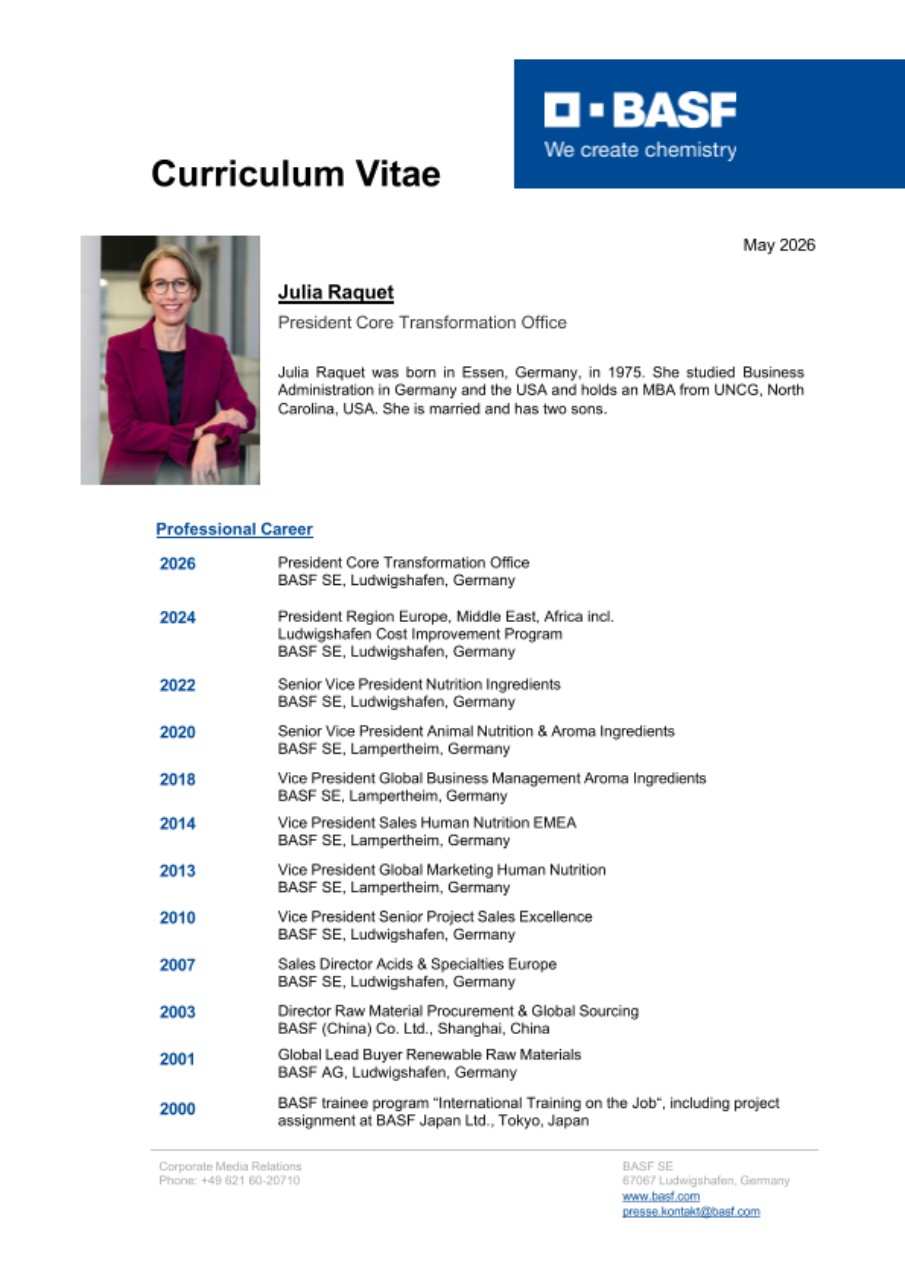
After the swift and almost complete carve-out of its standalone businesses, BASF is focusing on strengthening and growing its core businesses in the next phase of its “Winning Ways” strategy. The newly established Core Transformation Office, led by Julia Raquet (50), President, drives the implementation of cross-unit transformation projects across all core businesses, service units and corporate center units. The program, launched as “CoreShift,” aims to achieve up to 20% net cash fixed cost savings in the core by 2029, compared with the 2024 baseline. In her new role, Julia Raquet reports directly to Dr. Markus Kamieth, Chairman of the Board of Executive Directors of BASF SE.
“Our core businesses stand for strong market positions, for driving innovation and for enabling the green transformation of our customers. By carving out the standalone businesses, we are creating a more focused and coherent core,” said Kamieth. “Our clear focus is to leverage best-in-class competitiveness and synergies across our core businesses to lift their earnings power.”
BASF’s core businesses comprise four segments – Chemicals, Materials, Industrial Solutions and Nutrition & Care – that represent around €40 billion in global sales and position BASF as the world’s largest diversified chemical company. The core businesses fit very well together: From upstream to downstream, they are deeply integrated in long value chains. BASF sells products at every step in the value chain, supported by competitive technologies and local-for-local production in all regions. Together, these businesses form a focused core portfolio that offers an opportunity for further simplification.
“Simplifying the operating model of our core is essential to ensure best-in-class competitiveness and drive profitable growth,” said Julia Raquet. “Our efforts to deliver on this ambition are already in full swing, including restructuring our largest Verbund site in Ludwigshafen and reshaping our global service units.”
“CoreShift” builds on ongoing initiatives and goes further by applying a global, cross-unit transformation approach. Key enablers of this transformation include further simplification of operations and organization, globally harmonized business processes and corresponding standardized IT solutions enabled by a dedicated ERP (Enterprise Resource Planning) system for the core businesses as well as the increasing use of AI across BASF Group.About BASF
At BASF, we create chemistry for a sustainable future. Our ambition: We want to be the preferred chemical company to enable our customers’ green transformation. We combine economic success with environmental protection and social responsibility. Around 108,000 employees in the BASF Group contribute to the success of our customers in nearly all sectors and almost every country in the world. Our portfolio comprises, as core businesses, the segments Chemicals, Materials, Industrial Solutions, and Nutrition & Care; our standalone businesses are bundled in the segments Surface Technologies and Agricultural Solutions. BASF generated sales of around €60 billion in 2025. BASF shares are traded on the stock exchange in Frankfurt (BAS) and as American Depositary Receipts (BASFY) in the United States. Further information at www.basf.com.
P-26-105