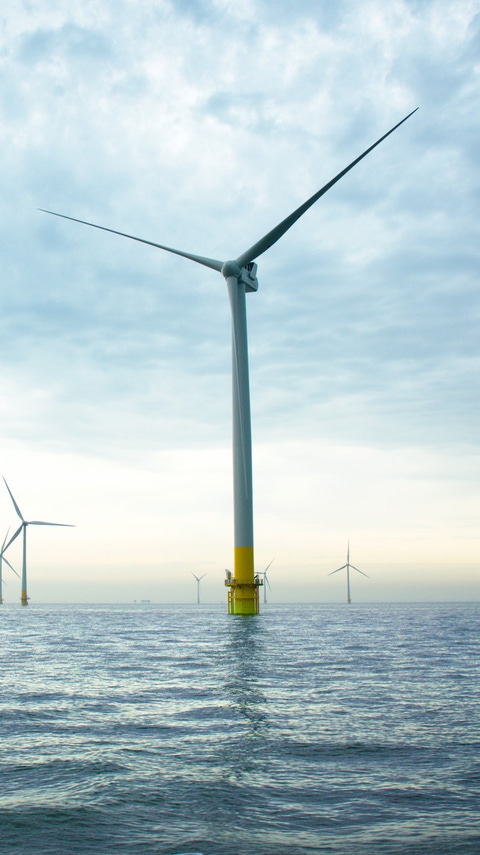
Image of an already existing Vattenfall wind farm. (Vattenfall)
March 25, 2026

Media

How does BASF reduce CO2 emissions?

Dr. Christoph Jäkel is Vice President Corporate Sustainability at BASF. In our interview he explains how BASF reduces CO2 emissions, shifts to renewable energy, and works together with customers to pursue new paths toward a circular economy. Here you can listen to the interview in our podcast.  

What does the green transformation mean for BASF? 

Our goal is to be the preferred chemical company to enable our customers’ green transformation and to focus on solutions that create the most value for them. BASF has ambitious targets on the road to climate neutrality and aims to achieve net zero emissions by 2050.

Christoph Jäkel is Vice President Corporate Sustainability at BASF.
Offshore wind turbines
 Wind energy is one of the cleanest sources of energy.

How does BASF reduce its CO2 emissions? 

We see three major levers for this:  

  1. Using green energy,  
  2. Using alternative raw materials in production, and  
  3. Improving production processes.  

What counts right now is to be open for all technologies, including among others carbon capture and storage to decarbonize existing assets.

BASF will soon open a new Verbund site in Zhanjiang in China. What about its CO2 emissions?  

The new site in Zhanjiang is a global role model in chemical production. By using 100 percent renewable electricity and innovative technologies we could reduce its CO2 emissions by 50 percent. Take the compressors of our steamcracker as example: They compact the gas which is generated after cracking the naphtha. Traditional compressors are powered by burning fossil fuels. In Zhanjiang we use electric motors powered by renewable energy. This reduces CO2 emissions by about 25 percent compared to a conventional cracker. 

How does the Verbund system contribute to reducing CO2?

Verbund means that the single plants of a site are interconnected. By-products, heat or steam of one process are used to produce products in other processes. This saves raw materials and energy, avoids emissions, lowers logistics costs, and leverages synergies – and by doing all of this, it also saves CO2.

Picture of the the new Zhanjiang Verbund site in China taken from birds' perseptive
The new Zhanjiang Verbund site in China is BASF’s third-largest site worldwide.
Wood pellets
Biomass such as wood pellets releases less CO2 than fossil raw materials. 

Which role do raw materials play?

Oil and gas remain important raw materials to produce chemicals, but today they can be step-by-step replaced by biomass coming from sources like wood, straw or organic waste for example. This makes a huge difference: When you burn fossil fuels, they quickly release a huge amount of carbon dioxide that has been stored for millions of years. Biomass is completely different. It only releases as much CO2 as was bound in the natural cycle shortly before.

Can you give a product example?  

The outdoor specialists at VAUDE have used an innovative BASF polyamide – a special kind of plastic – for a new bicycle backpack: To produce it, we use electricity from wind power and replace naphtha with bionaphtha from used cooking oil and natural gas with biomethane. We have developed a method that allows us to calculate exactly how much of the environmentally friendly raw materials are required and thus being fed into our value chain: this is called mass balance and is certified by external partners. The resulting polyamide has a product carbon footprint from cradle to gate of zero. It works just as well as the conventional one – and is more environmentally friendly.

Frank Reil, Marcel Schmitt (both BASF) and René Bethmann (VAUDE) with the new TRAILCONTROL ZERO 20+ backpack.
Frank Reil, Marcel Schmitt (both BASF) and René Bethmann (VAUDE) with the new TRAILCONTROL ZERO 20+ backpack. 

Sustainable products have their price. How do your customers and consumers react?

The unpleasant reality is: Today there is hardly any price premium for green products such as low carbon, bio-based and circular products. At least not in the broadness of the markets, like we need it to support the larger upstream decarbonization projects. Like any other company, BASF can only commit to the environment and society if it is also economically successful. A transformation towards a circular economy is only possible if we work together with partners from various industries to establish new economic systems. To achieve this, we need a new mindset – shifting from thinking in value chains to acting within value cycles.

What do you think – how will the green transformation progress?

We have to find the right balance. Dreaming-up sustainable solutions that aren’t feasible or economically viable isn’t helpful – and neither is pretending climate change won’t affect us. We need a pragmatic approach to the challenges we face, and we need the courage to try out innovative technologies and approaches. Our task is to balance environmental, economic, and social considerations, ensuring that the “urgent” doesn’t always beat the “important”. There is no question: we must make the green transformation happen.

Trees from worms' perspective.

How do you reduce CO2 emissions in your private life? 

There are lots of opportunities for improvement, but to name one I have been able to stick to: For 3 years we’ve had solar panels on the roof, and I’m committed to avoiding gas for my commute. I drive a plugin hybrid (not yet fully electric) with a 100-kilometer electric range – more than enough for my 20-kilometer commute. I can recharge at home and keep my driving virtually fully solarpowered.  

Christoph Jäkel is Vice President Corporate Sustainability at BASF. He studied chemistry and earned his doctorate at the University of Bonn, Germany. After his time as a postdoctoral researcher at Stanford University in the United States, Jäkel joined BASF in 2002. He has held various roles in strategic planning, business development, and sales across multiple regions.