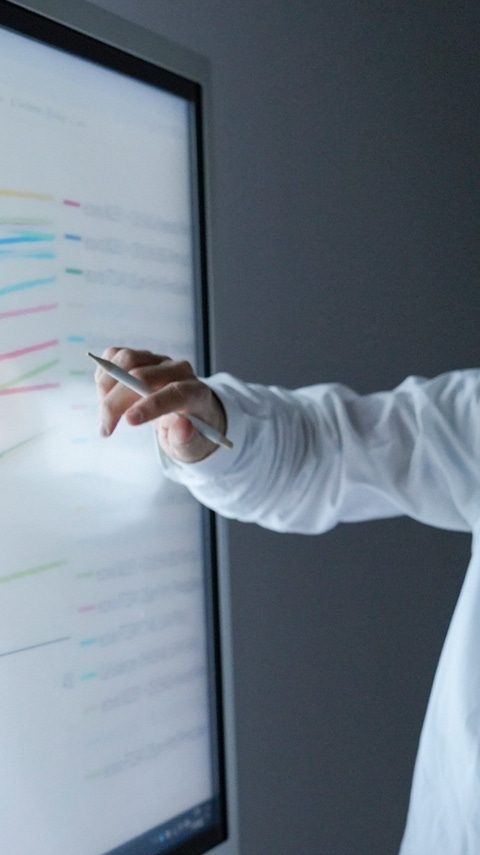
The use of digital tools supports work which is done in the labs, from app development and data structuring, to predictive modelling and automation.

Who we are

Digitalization in research and development

Our research and development competences are leading in the chemical industry. We aim to build on and leverage this strength to develop innovations together with our customers. One of the key levers for achieving this goal is digitalization.

Digital technologies are indispensable for everyday R&D operations

Digitalization gives our teams in research and development additional opportunities to implement their creative ideas and to collaborate intensively with others around the world. Here you can find more information on how we integrate digital technologies into everyday operations and make them an integral part of any project workflow:

BASF has started up a new supercomputer at its Ludwigshafen site. The new BASF supercomputer, named Quriosity like its predecessor, is the world’s largest supercomputer used in industrial chemical research. Significantly more complex modeling, virtual experiments and simulations are possible with its 3 petaflops computing power (1 petaflops equals one quadrillion floating point operations per second). Quriosity has more than 1,000 compute nodes and 3,000 terabytes of storage capacity. The photo shows a close-up of a compute node rack of BASF's new supercomputer.

Curious about Quriosity? 

Calculating the most promising polymer structure from thousands of possibilities? This is impossible for a normal computer. But it's no problem for our supercomputer Quriosity – thanks to the computing power of tens of thousands of laptops. Quriosity helps us to discover previously unknown relationships, to advance completely new research approaches and to substantially reduce development times. By the way, the supercomputer received its name from our employees following an online naming contest.

Get to know our supercomputer

For scientific and business work, more and more computing power is needed to answer increasingly complex questions. Classical digital approaches are gradually reaching their limits. New ways must be found to achieve the necessary computing power to handle huge volumes of data, to use artificial intelligence or to resolve answers more accurately while reducing the time to solution. That is why BASF invests into next generation computing technologies.

Learn more about Next Generation Computing and Quantum Computing at BASF 

Qritos – Multi-Criteria Optimization by BASF

In the new research building B007, BASF research moves closer together. Here, scientists from material physics, formulation and specialty chemicals research work door-to-door. They develop new solutions together with polymer chemists in the neighboring building. A bridge, shortening paths, interconnects the two buildings. 

Furthermore, open communication areas facilitate exchange between the scientific disciplines. This stimulates creative ideas, and benefits the efficient development of effective solutions.

Rui de Oliveira (left) and Karsten Seidel (right), from Material Physics, exchange experience and discuss research findings.

Make the most out of your R&D through Data Science

Find the best solution for complex product development based on state-of-the-art statistical trial planning and predictive modeling. Optimize your R&D and experience faster, cheaper and more reliable product development with our intuitive tool that does not require statistics or data science experience. Discover new formulations & recipes hidden in your own data – powered by machine learning.

Learn more

Development of new fungicide Revysol® supported by digital technologies

Revysol® is an innovative fungicidal active ingredient for crop protection from the triazole group. Unlike conventional azoles in the market, Revysol is the first Isopropanol-Azole, a unique chemistry discovered and developed by BASF combining an outstanding performance with a favourable regulatory profile and selectivity.

Digital technologies supported and accelerated the development of our new fungicide. A new ingredient needs to not only demonstrate high biological effectiveness, it also needs to meet registration requirements like favorable toxicological profile. Already in the early research phases, the screening process for fungicides was optimized and digital technologies like molecular modeling were employed to meet these various requirements, thus contributing to quick identification of compounds with optimal performance. 

Related content

Digitalization at BASF
Using digital technologies and data, we are creating additional value for our customers and increasing the efficiency and effectiveness of our processes.